


Healthcare Workforces Are Complex. Your Workday System Shouldn't Add to That Complexity.
- Apr 21
- 3 min read

How Alacrity Solutions supports hospitals, pharma, and biotech organisations under 5,000 headcount in taking full control of their Workday environment and reducing the operational burden of every future release.
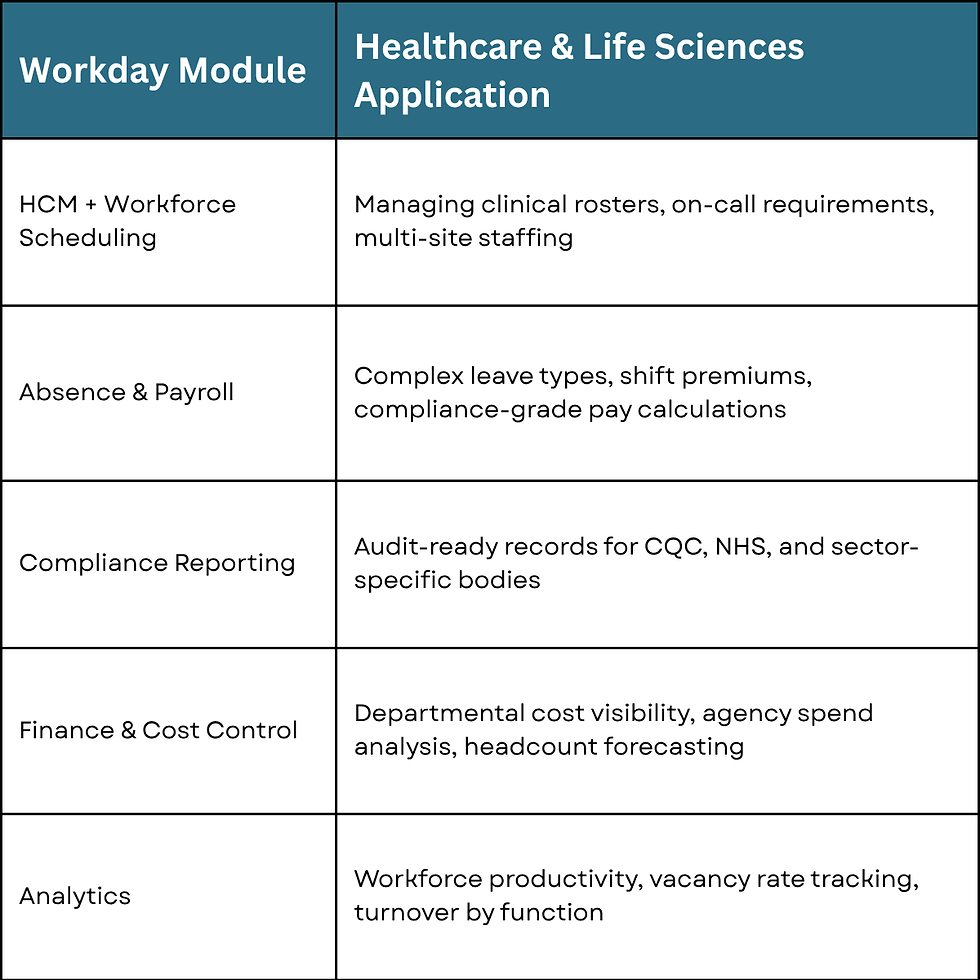
Healthcare and life sciences organisations carry some of the most demanding workforce management requirements of any sector. Shift-based scheduling. Highly regulated pay structures. Compliance reporting across multiple bodies. Frequent absence and leave management. And a workforce that includes everything from clinical staff to research teams to administrative functions.
Workday is one of the few platforms genuinely capable of handling this complexity. But capability and performance are not the same thing. For organisations that went live on Workday without a long-term optimisation plan, the gap between what the system can do and what it actually delivers tends to widen over time.
Alacrity Solutions helps healthcare organisations under 5,000 employees close that gap and keep it closed, through every release cycle.
The Workforce Management Imperative in Healthcare
The global healthcare workforce management market was valued at USD 2.38 billion in 2025 and is projected to reach USD 2.72 billion in 2026, growing at a CAGR of 14.4%, according to recent market research. The primary drivers are increasing compliance demands, complex staffing requirements, and accelerating adoption of digital HR systems.
For mid-sized healthcare and life sciences organisations, this translates into a practical reality: the systems you rely on for workforce management need to keep pace with both regulatory change and operational growth. Workday is well-positioned to deliver this but only when actively maintained and optimised.
2026 R1: What Healthcare Teams Should Action Now
Workday 2026 R1 went live on 14 March. For healthcare organisations, the most immediately relevant updates include improved absence and schedule visibility a significant addition for teams managing complex shift structures without requiring the full Workday Scheduling or Time Tracking modules.
The release also brings enhanced governance controls for Change Job workflows critical for healthcare organisations where role changes often carry compliance implications and the early rollout of Workday's new Self-Service Agent, designed to reduce the volume of routine HR queries reaching support teams.
Alacrity Insight: Healthcare organisations that build user self-service capability typically see material reductions in HR support ticket volume. One Workday customer cited a 45% year-on-year reduction following structured training and self-service enablement. In healthcare, where HR teams are routinely under-resourced, that efficiency saving directly frees capacity for higher-value work. |
The Challenge With Legacy Systems in Healthcare
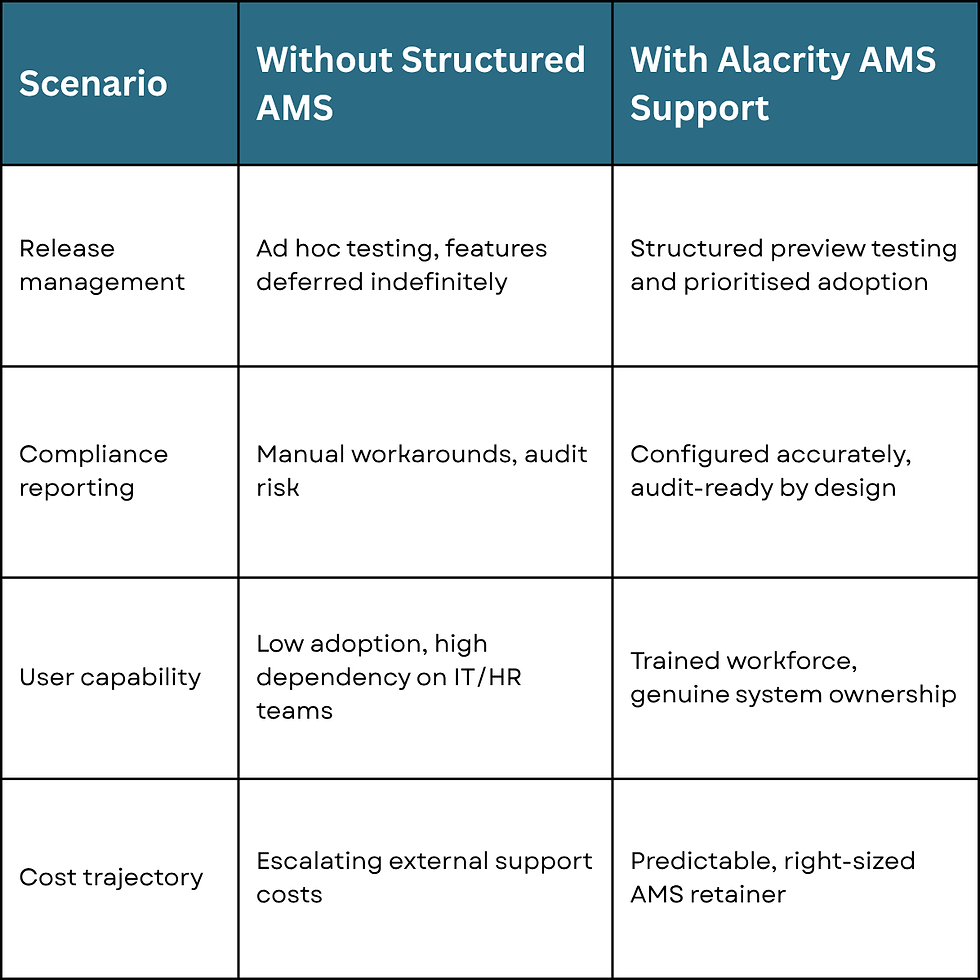
Many healthcare organisations came to Workday from legacy HR and payroll systems that were genuinely not fit for purpose. The implementation solved the most urgent problems. But the complexity of healthcare workforce management means there is almost always a second layer of optimisation work configuring Workday to handle sector-specific requirements properly that gets deferred.
That deferred configuration accumulates. By the time 2026 R1 arrives, some teams are managing unresolved items from two or three previous releases. Testing becomes harder. User confidence declines. The system starts to feel like a burden rather than an asset.
A Personal Service for Organisations at Your Scale
Alacrity Solutions does not operate like a large consulting firm. There are no account managers sitting between your team and Workday expertise. When you engage Alacrity, you work directly with experienced practitioners who understand healthcare workforce complexity and who have the in-house Workday knowledge, built over 30 years, to resolve it.
For organisations between 200 and 5,000 employees, this model is both more effective and more commercially sustainable than the alternatives. You gain consistent support through every release cycle, a team that understands your configuration, and a clear path toward the internal ownership that reduces your long-term support dependency.
Preparing for What Comes Next
Workday 2026 R2 will arrive later this year. Healthcare organisations that use the next few months to stabilise their configuration, build user capability, and close out deferred optimisation work will be in a significantly stronger position when it does.
Alacrity is ready to support that work at the scale and pace that mid-sized healthcare and life sciences organisations actually need.
About Alacrity Solutions
Alacrity Solutions provides expert Workday AMS support and workforce training for organisations under 5,000 headcount. With over 30 years of in-house Workday knowledge, Alacrity delivers a personal, sector-aware service at a sustainable cost.
Visit: www.alacrity-solutions.com


Comments